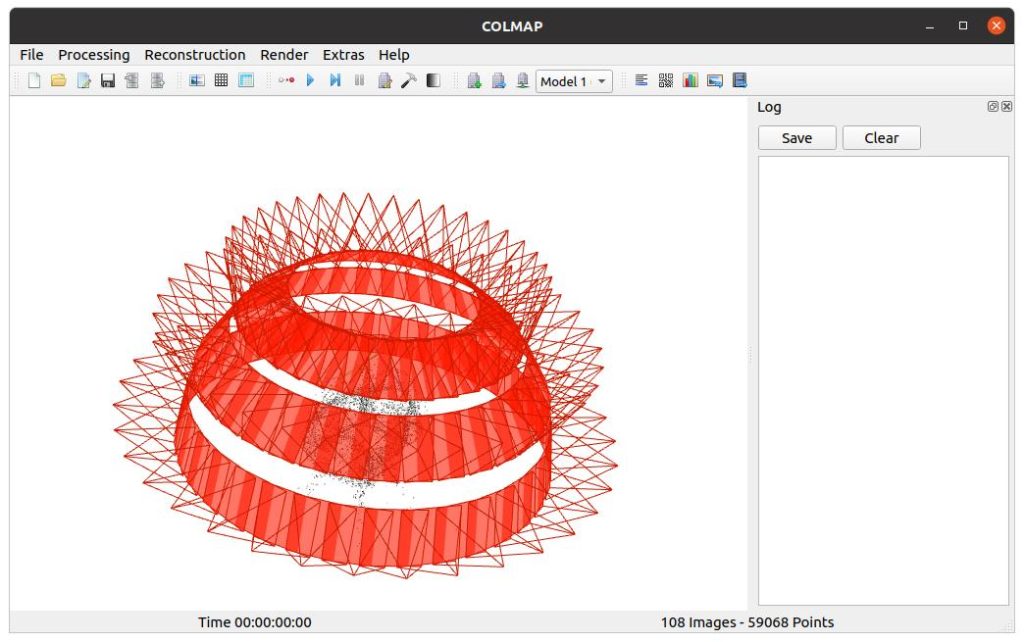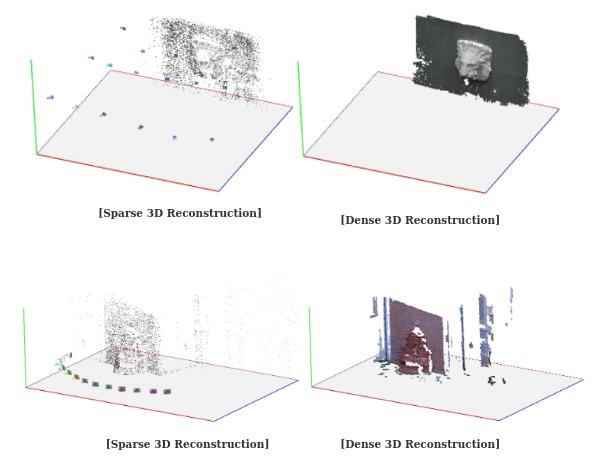
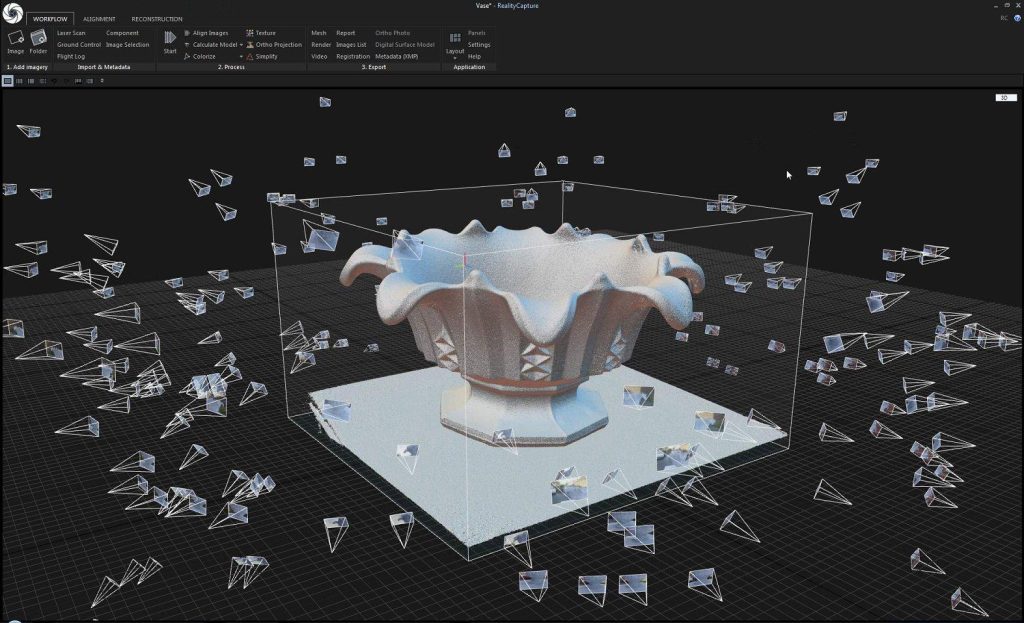
ColMap is a leading open-source software that performs high-quality image-based 3D reconstruction. It combines Structure-from-Motion (SfM) and Multi-View Stereo (MVS) techniques to generate accurate sparse and dense 3D models from collections of 2D photographs. The tool processes both ordered sequences, such as video frames, and completely unordered image sets captured from different viewpoints.
ColMap stands out for its robustness, modularity, and ability to handle challenging real-world datasets without requiring prior camera calibration in most cases. It offers a graphical user interface for interactive use and command-line tools for automation. The pipeline starts with feature detection in individual images, proceeds through correspondence establishment and geometric verification, builds a sparse reconstruction with camera poses, and finally produces a dense point cloud or textured mesh through stereo matching and fusion. This end-to-end approach makes ColMap a preferred choice for applications in photogrammetry, cultural heritage, robotics, visual effects, and neural rendering pipelines.
Overview of Image-Based 3D Reconstruction in ColMap
Image-based 3D reconstruction transforms collections of overlapping photographs into measurable digital models of real-world scenes. The core idea relies on the fact that the same three-dimensional point projects to different locations in multiple two-dimensional images depending on camera viewpoints. By identifying corresponding points across views, algorithms can simultaneously estimate camera positions, orientations, and the underlying 3D structure.
ColMap automates this complex process through a well-defined pipeline that separates concerns into modular stages. The software assumes the scene is largely static and that images have sufficient overlap and texture for reliable feature matching. It supports various camera models, including pinhole with radial distortion and fisheye lenses, allowing flexibility for different capture setups. The reconstruction typically produces two main outputs: a sparse point cloud with registered camera poses from SfM, followed by a dense point cloud or surface mesh from MVS.
What Is ColMap
ColMap serves as a general-purpose Structure-from-Motion and Multi-View Stereo pipeline. It reconstructs 3D scenes and estimates camera parameters directly from input images. The software stores project data efficiently in an SQLite database, enabling users to inspect intermediate results, resume interrupted processes, or incrementally add new images.
Originally developed with a strong focus on incremental SfM for robustness, recent versions integrate advanced global SfM capabilities through GLOMAP. This addition provides faster alternatives for large-scale datasets while maintaining competitive accuracy. ColMap runs on Windows, Linux, and macOS, with GPU acceleration via CUDA for key compute-intensive steps. Its open-source nature under a permissive license has made it a foundational tool that many research projects and commercial workflows build upon.
The Two-Stage Reconstruction Pipeline
ColMap divides 3D reconstruction into two primary phases that work sequentially. The first phase, Structure-from-Motion, recovers a sparse representation of the scene along with accurate camera poses. The second phase, Multi-View Stereo, uses this sparse output to compute dense depth information for nearly every pixel, resulting in a detailed 3D model.
This separation is deliberate and effective. SfM provides the necessary geometric foundation and camera alignments that enable reliable dense matching in the MVS stage. Without accurate poses from SfM, dense reconstruction would suffer from misalignment and noise. Users can run the full automatic pipeline with one command or execute individual modules for fine control and debugging.
Structure-from-Motion in ColMap
Structure-from-Motion reconstructs the 3D structure of a scene from its projections into multiple images while estimating camera motion. ColMap offers multiple SfM approaches, with the incremental mapper serving as the default and most robust option. It also supports hierarchical reconstruction for very large scenes and a global mapper based on GLOMAP for improved scalability.
The incremental approach builds the model gradually, starting from a small reliable subset and expanding step by step. This method excels at handling noisy data, partial overlaps, and varying image quality common in real-world captures. Global methods solve for all camera poses more simultaneously, offering speed advantages on massive datasets while recent improvements bring accuracy closer to incremental results.
Feature Detection and Extraction
The pipeline begins with feature detection and extraction applied independently to every input image. ColMap identifies distinctive keypoints such as corners, edges, or textured regions that remain stable across different viewpoints and lighting conditions.
The software traditionally relies on the SIFT algorithm, which provides scale-invariant and rotation-invariant descriptors. GPU-accelerated implementations significantly speed up this stage. Users can also employ modern learned features and matchers for improved performance in specific scenarios, such as low-texture environments or repetitive patterns. Each keypoint receives a descriptor vector that encodes local image appearance, enabling efficient comparison in later matching stages.
Extracted features and descriptors are stored in the project database along with any available EXIF metadata, which helps initialize camera intrinsics like focal length.
Feature Matching and Geometric Verification
Once features are extracted, ColMap establishes correspondences between images through feature matching. For small collections, exhaustive matching compares features across every image pair. For larger datasets, efficient vocabulary tree or bag-of-words retrieval quickly identifies likely overlapping pairs, followed by detailed descriptor matching.
A ratio test filters ambiguous matches, while geometric verification applies robust estimation techniques such as RANSAC to compute fundamental or essential matrices. This step confirms that matches are consistent with projective geometry and removes outliers. ColMap supports multiple matching modes, including sequential for ordered captures and spatial when GPS data is available.
The output is a scene graph where images form nodes and verified match pairs form edges. This graph guides the subsequent reconstruction by highlighting connectivity and overlap between views.
Incremental Reconstruction Process
ColMap’s incremental mapper starts with careful selection of an initial image pair that shares many high-quality matches and exhibits well-conditioned geometry. From this seed pair, the algorithm estimates relative camera poses and triangulates the first set of 3D points.
New images are then registered one by one using the Perspective-n-Point solver, which determines the pose of a new camera based on its observed 3D points. Once registered, additional points visible in the new image are triangulated from multi-view observations. The process repeats, gradually expanding the reconstructed model.
Throughout incremental growth, ColMap applies several robustness mechanisms. It selects the next best image based on the number of matches to the current model, filters outliers using reprojection error thresholds, and enforces minimum track lengths for points to ensure reliability.
Bundle Adjustment and Model Refinement
Bundle adjustment serves as the critical optimization step that maintains accuracy across the growing reconstruction. This non-linear least-squares problem simultaneously refines all camera poses, intrinsics, and 3D point positions by minimizing the total reprojection error. Reprojection error measures how closely the projected 3D points match their observed 2D locations in the images.
ColMap performs local bundle adjustment on recently added parts for speed and periodic global bundle adjustment to correct accumulated drift. It uses efficient solvers like Ceres with the Schur complement to handle large sparse problems. Outlier filtering continues during optimization, removing observations that exceed error thresholds.
This iterative refinement ensures global consistency, reduces drift in long sequences, and improves the overall quality of the sparse point cloud and camera parameters.
Camera Models and Calibration Handling
Accurate modeling of camera intrinsics and distortion is essential for precise reconstruction. ColMap supports multiple camera models, ranging from simple pinhole to those accounting for radial and tangential distortion, as well as fisheye projections.
The software can perform self-calibration when intrinsics are unknown, estimating parameters directly from image data during bundle adjustment. When EXIF data provides initial focal length estimates, ColMap uses them to bootstrap the process. Shared intrinsics across images from the same camera improve efficiency and consistency.
Joint optimization of intrinsics and extrinsics within bundle adjustment allows ColMap to refine camera models alongside the 3D structure, leading to more accurate results even for uncalibrated consumer cameras.
Transition to Dense Reconstruction
After completing the sparse SfM stage, ColMap produces a set of registered images with known camera poses and a sparse point cloud. This output serves as input for the Multi-View Stereo phase, which aims to recover depth information at a much higher density.
The transition includes an undistortion step that removes lens distortions from the images using the refined camera parameters. Undistorted images ensure that pixel correspondences align correctly for dense stereo matching.
Multi-View Stereo Pipeline
Multi-View Stereo computes dense depth maps for each image by matching pixels across multiple views. ColMap employs a PatchMatch-based stereo algorithm that efficiently propagates depth hypotheses from reliable seed points across neighboring pixels using local image patches.
Pixel-wise view selection chooses the most suitable reference images for each target pixel, avoiding occlusions and large baseline distortions. The algorithm estimates both depth and surface normals, improving geometric consistency.
This per-view depth computation runs efficiently with GPU acceleration, though it remains memory-intensive for high-resolution images.
Depth Map Fusion and Point Cloud Generation
Individual depth maps often contain inconsistencies due to occlusions, noise, or matching ambiguities. ColMap’s stereo fusion stage merges these depth maps into a unified dense point cloud while filtering outliers and resolving conflicts.
The fusion process considers consistency across multiple views and applies robust filtering to produce a clean, detailed 3D representation. Users can control parameters such as consistency thresholds to balance completeness and accuracy.
The resulting dense point cloud captures fine surface details that the sparse model cannot represent, making it suitable for visualization, measurement, or further processing.
Surface Reconstruction and Texturing
From the dense point cloud, ColMap can generate a surface mesh using techniques like Poisson surface reconstruction. Mesh simplification options reduce polygon count while preserving important geometric features.
Texturing maps colors from the original input images onto the mesh vertices or faces, creating visually realistic 3D models. The software handles texture blending to minimize seams and lighting variations across different source images.
Users can export the final mesh in common formats for use in external tools like Blender or game engines.
Alternative Reconstruction Strategies
While incremental SfM remains the default for its robustness, ColMap offers alternatives. The hierarchical mapper partitions large scenes into overlapping sub-models, reconstructs them independently, and merges the results. This approach helps manage memory and computation for very large collections.
The global mapper, powered by GLOMAP integration, solves for camera rotations and positions more globally using rotation averaging and global positioning techniques. It provides significant speed improvements on massive datasets while achieving accuracy comparable to incremental methods in many cases.
Users select the appropriate strategy based on dataset size, desired trade-offs between speed and robustness, and available computational resources.
Best Practices for High-Quality Reconstruction
Successful 3D reconstruction in ColMap depends heavily on input data quality. Capture images with 60 to 80 percent overlap between neighboring views, vary camera angles and distances, and ensure good texture and even lighting across the scene. Avoid extreme viewpoint changes or low-texture surfaces that challenge feature matching.
Begin with the automatic reconstruction workflow to obtain quick results, then inspect the sparse model for registration coverage. Add missing images or adjust matching parameters if parts of the scene remain unregistered. For dense stages, monitor GPU memory usage and consider reducing resolution during initial tests.
Periodic inspection of intermediate results through the graphical interface helps identify and correct issues early. Export sparse models regularly to preserve progress before dense computation.
Factors Affecting Reconstruction Quality
Several factors influence the final output quality. Image resolution directly affects detail level but increases computation and memory demands. Feature matching robustness determines how well the scene graph connects, while bundle adjustment frequency controls drift and accuracy.
Camera model choice and calibration quality affect geometric precision. In metric applications, incorporating known distances or scale information helps recover absolute units from the inherently scale-ambiguous SfM output.
Environmental challenges such as repetitive textures, moving objects, or varying illumination require careful parameter tuning or additional images to achieve reliable results.
Integration with Modern Workflows
ColMap outputs integrate seamlessly with downstream applications. Sparse reconstructions provide strong geometric priors for Neural Radiance Fields or 3D Gaussian Splatting. Dense point clouds and meshes serve as input for rendering, simulation, or measurement software.
Python bindings through PyCOLMAP enable custom pipelines and machine learning integrations. The modular design allows researchers to replace individual components, such as using learned feature matchers while retaining ColMap’s robust reconstruction engine.
Conclusion
ColMap performs 3D reconstruction from images through a sophisticated pipeline that begins with feature extraction and matching, builds an accurate sparse model via incremental or global Structure-from-Motion with bundle adjustment, and completes the process with dense Multi-View Stereo depth estimation and fusion. Its combination of robustness, flexibility, and high-quality outputs has established it as a cornerstone tool in computer vision and photogrammetry.