ColMap is a widely used open-source software for image-based 3D reconstruction that implements both incremental and global approaches to Structure-from-Motion (SfM). These two methods represent fundamentally different strategies for estimating camera poses and reconstructing the sparse 3D structure from collections of overlapping images. The choice between them significantly impacts reconstruction speed, robustness, scalability, and final accuracy.
Incremental SfM, the traditional default in ColMap, builds the model gradually by starting with a small reliable subset of images and adding one image at a time. Global SfM, enhanced through the integration of GLOMAP in recent ColMap versions, solves for all camera poses simultaneously using techniques like rotation averaging and global positioning. Understanding these differences helps users select the most suitable pipeline based on dataset size, image quality, and computational resources.
Overview of Structure-from-Motion in ColMap
Structure-from-Motion recovers the three-dimensional geometry of a scene along with the positions and orientations of the cameras that captured the images. ColMap performs SfM as the first major stage of its reconstruction pipeline before proceeding to dense Multi-View Stereo. Both incremental and global SfM share common early steps such as feature extraction and matching but diverge in how they estimate camera parameters and triangulate points.
ColMap offers three main SfM pipelines: the default incremental mapper, the hierarchical mapper for very large scenes, and the global mapper powered by GLOMAP. The incremental approach has long been favored for its superior robustness and accuracy in handling real-world challenges like noise, outliers, and partial overlaps. Global methods, while historically less robust, have gained significant improvements in accuracy while maintaining their primary advantage of speed and scalability.
What Is ColMap
ColMap serves as a comprehensive open-source tool that combines Structure-from-Motion with Multi-View Stereo to create accurate sparse and dense 3D models from unordered or ordered image collections. It requires no prior camera calibration in most cases and supports a variety of camera models including pinhole with distortion and fisheye lenses.
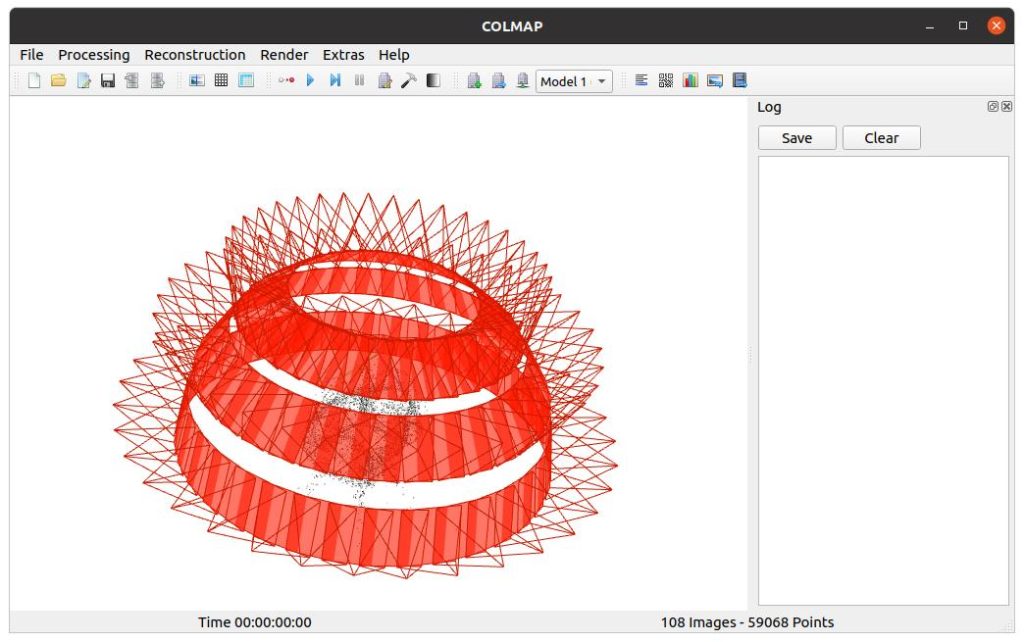
The software stores project data in an SQLite database, enabling efficient management of features, matches, and intermediate reconstructions. Users interact with ColMap through a graphical user interface for visualization and manual control or through command-line tools for automation and large-scale processing. Recent releases have integrated the GLOMAP global SfM system as a first-class citizen, making both incremental and global pipelines readily accessible via commands such as the mapper or automatic_reconstructor with appropriate flags.
Fundamental Concepts of Incremental SfM
Incremental SfM reconstructs the scene by starting small and growing the model step by step. The process begins with the selection of a robust initial image pair that shares many high-quality feature matches and exhibits favorable geometric conditions. From this seed, ColMap estimates the relative pose between the two cameras and triangulates the first set of three-dimensional points.
Subsequent images are registered one at a time using the Perspective-n-Point solver, which determines the new camera’s pose based on its observed 3D points from the existing model. Once registered, additional points visible in the new image but not yet reconstructed are triangulated from multiple views. This sequential addition continues until no more images can be reliably incorporated.
The incremental nature allows ColMap to apply extensive outlier filtering and robustness checks at each step. Images with insufficient matches or poor geometry are deferred or rejected, preventing early errors from propagating through the entire model.
How Incremental SfM Works in ColMap
The incremental mapper in ColMap follows a carefully designed workflow. After feature extraction and geometric verification create a scene graph of overlapping images, the mapper selects the best initial pair based on criteria such as the number of matches and the conditioning of the two-view geometry.
Registration of new images prioritizes those with the highest number of connections to the current model. Triangulation adds new points, while periodic bundle adjustment refines all camera poses and 3D points by minimizing reprojection error. Local bundle adjustment optimizes recently added components for efficiency, while global bundle adjustment runs less frequently to correct accumulated drift across the whole reconstruction.
ColMap employs robust techniques throughout, including reprojection error thresholds, minimum track length requirements for points, and iterative filtering of outliers. This careful design makes the incremental pipeline highly tolerant to noisy matches, varying image quality, and incomplete overlaps common in practical datasets.
Advantages of Incremental SfM
Incremental SfM excels in robustness and accuracy. By building the model gradually and performing repeated refinement through bundle adjustment, it effectively suppresses the influence of outliers and prevents error accumulation in challenging scenarios. This approach often produces more complete and reliable reconstructions, especially when the image collection contains ambiguities, repetitive structures, or varying lighting conditions.
The method allows real-time monitoring in the graphical interface, where users can observe the model growing and intervene if necessary by adjusting parameters or adding images. For metric accuracy and applications requiring high precision, such as cultural heritage documentation or surveying, incremental SfM has traditionally delivered superior results.
Limitations of Incremental SfM
The primary drawback of incremental SfM is computational scalability. As the model grows, each new image registration and subsequent bundle adjustment becomes more expensive because the optimization involves an increasing number of cameras and points. For datasets containing thousands or tens of thousands of images, processing times can extend to days or even weeks on standard hardware.
Drift can still occur in very long sequences if global bundle adjustment is not performed frequently enough. The sequential nature also means that poor choices early in the process, such as a suboptimal initial pair, can affect the quality of the final reconstruction, although ColMap mitigates this through careful initialization strategies.
Fundamental Concepts of Global SfM
Global SfM takes a fundamentally different approach by attempting to estimate the geometry of all cameras simultaneously rather than sequentially. It operates on the view graph formed by verified image pairs and their relative geometries. The pipeline typically separates the estimation into rotation averaging and translation or position estimation steps.
In global methods, camera rotations are first recovered across the entire graph using rotation averaging techniques that enforce consistency of relative rotations. Camera positions or translations are then estimated globally, often through more complex optimization that considers all two-view constraints at once. Finally, 3D points are triangulated using the recovered poses.
This all-at-once strategy avoids the sequential error propagation inherent in incremental methods and can leverage the full connectivity of the view graph for more consistent solutions.
How Global SfM Works in ColMap with GLOMAP
ColMap integrates the GLOMAP system as its global SfM pipeline. GLOMAP improves upon earlier global approaches by addressing key weaknesses, particularly in the global positioning step. Instead of performing separate and often ill-posed translation averaging followed by triangulation, GLOMAP performs joint estimation of camera positions and 3D points.
The pipeline begins with view graph calibration to refine intrinsics from two-view geometries. It then conducts global rotation averaging to obtain consistent camera orientations. The core innovation lies in the global positioning stage, which jointly optimizes camera locations and structure. A final refinement stage with bundle adjustment polishes the reconstruction.
This design makes the global mapper significantly faster while closing the accuracy gap with incremental methods. In ColMap, users can invoke the global mapper directly or select it within the automatic reconstruction workflow.
Advantages of Global SfM
The standout advantage of global SfM is scalability and speed. By solving for all poses in a more holistic manner, it avoids the repeated expensive optimizations required when adding images incrementally. On large datasets, global methods can be orders of magnitude faster, reducing reconstruction time from days to hours in many cases.
Global approaches also benefit from considering the entire view graph simultaneously, which can lead to more globally consistent camera poses, especially in well-connected scenes. With improvements in GLOMAP, global SfM now achieves accuracy and robustness that are on par with or, in some metrics, superior to traditional incremental SfM while maintaining its efficiency edge.
Limitations of Global SfM
Despite recent advances, global SfM can still be more sensitive to outliers in the matching stage. Poorly conditioned view graphs or a high percentage of incorrect matches can destabilize the rotation or positioning steps, leading to failures in registering certain images or producing distorted geometry.
In some cases, global methods may produce occasional large errors in individual camera poses that require manual filtering or post-processing. While GLOMAP has narrowed this gap considerably, incremental SfM often remains more consistent and forgiving for highly challenging or sparsely connected datasets without additional tuning.
Direct Comparison Between Incremental and Global SfM
The core philosophical difference lies in the reconstruction strategy. Incremental SfM grows the model locally and refines it iteratively, emphasizing robustness through repeated checks and optimizations. Global SfM solves a larger optimization problem holistically, prioritizing efficiency and global consistency.
In terms of accuracy, incremental SfM has historically held the advantage due to its extensive outlier rejection and frequent bundle adjustments. However, GLOMAP integration in ColMap has brought global SfM to a level where it matches or exceeds incremental performance on many benchmarks while being dramatically faster.
Scalability favors global SfM for large collections. Incremental methods scale poorly because optimization cost grows with model size, whereas global methods handle thousands of images more gracefully. Memory usage and computational requirements also differ, with global pipelines often demanding more peak memory during the simultaneous pose estimation but completing faster overall.
Robustness to noisy data still leans toward incremental SfM in difficult scenarios, although careful parameter tuning and strong feature matching can make global SfM reliable. For completeness of reconstruction, incremental methods tend to register more images successfully in sparse or ambiguous scenes.
Hierarchical SfM as a Middle Ground
ColMap also provides a hierarchical mapper that combines elements of both approaches. It partitions large scenes into smaller overlapping sub-models, reconstructs them incrementally or globally, and then merges the sub-reconstructions. This hybrid strategy improves scalability for very large datasets while retaining much of the robustness of incremental reconstruction.
Hierarchical SfM serves as a practical compromise when neither pure incremental nor pure global mapping fully meets the needs of extremely large projects.
Choosing the Right SfM Pipeline in ColMap
Selecting between incremental and global SfM depends on several factors. For small to medium datasets under a few hundred images where maximum robustness is desired, the default incremental mapper remains an excellent choice. It offers proven reliability and easy monitoring through the graphical interface.
For large-scale collections with thousands of images and good connectivity in the view graph, the global mapper with GLOMAP provides substantial time savings with comparable quality. Users should evaluate the matching graph quality first; well-connected graphs with few outliers favor global SfM.
When in doubt, start with the automatic reconstruction using the incremental mapper for safety. If processing time becomes prohibitive, switch to the global mapper and compare results. ColMap allows easy experimentation since both pipelines operate on the same feature and match database.
Hardware resources also influence the decision. Global SfM may require more peak memory during joint optimization, while incremental SfM spreads computation over a longer period with more frequent smaller optimizations.
Practical Considerations and Parameter Tuning
Successful use of either pipeline requires attention to upstream steps. High-quality feature matching and geometric verification are crucial for both, but global SfM can be more sensitive to residual outliers. Adjusting matching parameters, such as the ratio test threshold or the number of RANSAC iterations, can improve results for global mapping.
In the global mapper, parameters related to rotation averaging, positioning tolerances, and final bundle adjustment iterations can be tuned for specific datasets. ColMap documentation and the FAQ provide guidance on choosing and configuring the different mappers.
For hybrid workflows, users sometimes run global SfM for fast initial pose estimation and then refine selected parts incrementally. The modular design of ColMap supports such advanced strategies.
Impact on Downstream Dense Reconstruction
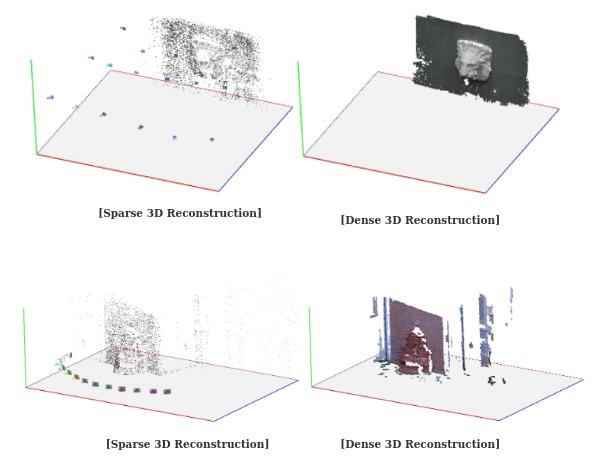
The choice of SfM method affects the quality of the sparse model that feeds into Multi-View Stereo. A more accurate and complete sparse reconstruction with reliable camera poses generally leads to better depth map estimation and cleaner dense point clouds.
Incremental SfM often provides slightly more stable camera alignments for dense stages, while global SfM delivers poses faster, enabling quicker iteration in the overall pipeline. In practice, both can produce excellent dense results when the input images have sufficient overlap and texture.
Real-World Performance Examples
On standard benchmarks, incremental SfM in ColMap delivers high completeness and low error rates but at the cost of longer runtimes. Global SfM with GLOMAP achieves similar or better recall rates in significantly less time, sometimes completing reconstructions that would take days with incremental methods in just a few hours.
For internet-scale photo collections or large cultural heritage sites, the speed advantage of global SfM makes previously impractical projects feasible. In controlled indoor or object scanning scenarios with high overlap, incremental SfM may still edge out in consistency.
Future Developments in ColMap SfM
The integration of GLOMAP marks a significant evolution in ColMap, bringing powerful global capabilities into the main codebase. Ongoing improvements focus on further closing any remaining robustness gaps, enhancing multi-GPU support, and integrating learned features more deeply into both pipelines.
Hybrid and adaptive approaches that automatically select or combine incremental and global strategies based on dataset characteristics are likely areas of continued research and development.
Conclusion
ColMap provides users with powerful options through its incremental and global SfM pipelines, each with distinct strengths suited to different reconstruction needs. Incremental SfM offers proven robustness and accuracy by building the model sequentially with extensive refinement, making it ideal for challenging or smaller datasets. Global SfM, enhanced by GLOMAP, delivers superior speed and scalability while achieving competitive or superior accuracy on many large, well-connected collections.